
In the fisheries agribusiness ecosystem and national marine resource management, mastering fish classification exceeds basic taxonomic biology. The fundamental difference between pelagic and demersal fish is the determining instrument in designing the maritime operational value chain, from catch technology engineering, aquaculture and nutrition strategies, cold chain management, to global market penetration analysis. Conceptually, this classification rests on ecological habitat zoning, mapping where a species spends most of its life cycle in the water column. This ecological zoning ultimately dictates morphological shape, metabolic rate, and the commercial value of each fisheries commodity.
Mapping these two marine "worlds" is crucial given Indonesia's macroeconomic fisheries data. Based on the Minister of Marine Affairs and Fisheries Decree (Kepmen KP) Number 19 of 2022, the estimated Maximum Sustainable Yield (MSY) in the 11 Fisheries Management Areas of the Republic of Indonesia (WPPNRI) reaches 12.01 million metric tons per year. To guarantee marine ecosystem sustainability, the government set the Allowable Catch (JTB) at 8.6 million metric tons per year. This regulation marks a significant management paradigm shift; previously, JTB was uniformly applied at 20 percent for all commodities, but now exploitation quotas are calculated based on the specific vulnerability of nine fish resource groups, including a clear separation between large pelagics, small pelagics, demersals, and reef fish.
The massive sustainable potential of 12.01 million metric tons affirms the fisheries sector's central role in national food security and foreign exchange generation. Pelagic fish dominate catch volumes supporting mass processing industries and daily protein consumption, while demersal fish fill the premium market niche oriented toward high added value. Therefore, a deep understanding of pelagic and demersal ecological characteristics is not merely academic insight, but the foundation for business risk mitigation and determining profit margins for every industry player from upstream to downstream sectors.
The Pelagic World: ecological characteristics and national canning industry hubs
Etymologically, pelagic derives from the Greek pelagos, meaning "open sea". Pelagic fish are wanderers inhabiting the open water column, a transitional zone not touching the seabed but not always directly at the surface. Their existence holds a dual ecological function; besides acting as predators and prey in the food web, they often serve as biological indicators for ocean current fluctuations, plankton availability, and global sea surface temperature dynamics.
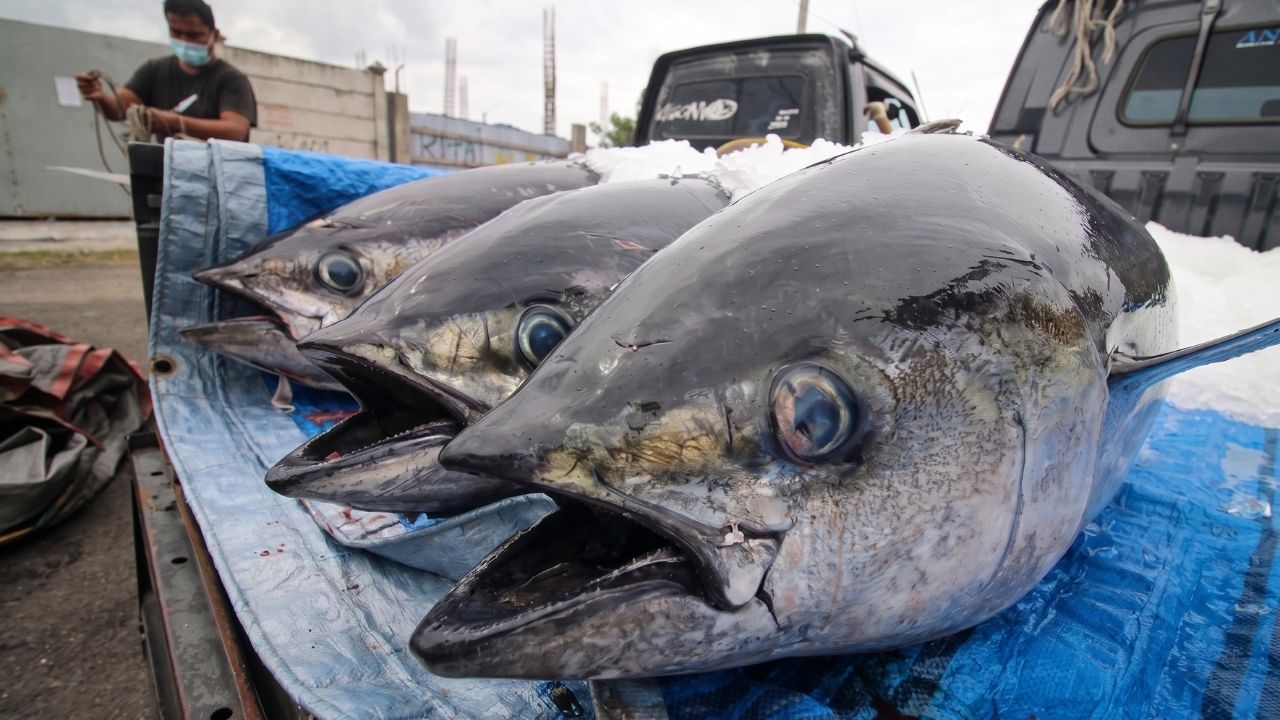
The biological traits of pelagic fish evolved perfectly to support a nomadic open-ocean lifestyle. Their main defining characteristics include high mobility and long-distance migration. As active swimmers, pelagic fish migrate across WPPNRI boundaries following currents and water temperature gradients to find optimal feeding and spawning grounds. They have an aerodynamic body morphology. Adapting to speed needs, they possess a fusiform (torpedo-like) shape. This evolution minimizes water drag when swimming rapidly to evade predators or pursue prey. They rely on a countershading camouflage system. Their backs are dark (dark blue or blackish) to camouflage from aerial predators above, while their bellies are bright or silvery to blend with sunlight if stalked from the depths. High movement intensity demands massive energy reserves, stored as lipids distributed evenly throughout muscle tissues. This characteristic makes pelagic fish "oily fish," the primary and richest source of unsaturated Omega-3 fatty acids essential for human health.
In commercial agribusiness, this group is divided into small pelagics that tend to live in giant schools (anchovies, mackerel, scad, lemuru) and large pelagics at the top of the food chain (tuna, skipjack, little tunny, Spanish mackerel). These species are caught in massive tonnages and form the lifeblood for the global canning industry.

Center of gravity for the national canning industry
Industry reliance on massive supply volumes creates strategic economic centers. In Indonesia, the fish canning industry's strength map is distributed based on efficient proximity to WPPs:
- Muncar, Banyuwangi (East Java): As Indonesia's oldest and largest small pelagic canning hub, Muncar relies on the Bali Strait's productivity. It is the epicenter for processing Sardinella lemuru, sardines, and mackerel, supplying domestic needs and expanding exports to Southeast Asia and Africa.
- Bitung (North Sulawesi): Dubbed the "City of Skipjack," Bitung is a large pelagic hub exploiting WPP 716 (Sulawesi Sea) and 717 (Pacific Ocean). It focuses on processing premium tuna into canned tuna (in oil or brine) for the United States, Japan, and the European Union.
- Jembrana (Bali): Located in Pengambengan, this area grows rapidly as an industrial buffer for East Java. When currents divert lemuru stocks south of the Bali Strait, Jembrana plays a crucial role in maintaining raw material supply stability.

Lemuru fish (sardine) catch at the Putra Mandiri Joint Business Group, Pengambengan Village, Jembrana: Luhkan Kab. Jembrana/I Made Susi Erawan
The success of these centers does not solely depend on wild fish availability but is driven by supporting industrial factors: Absolute proximity to raw materials significantly reduces travel distance from the ship's hold to the factory, suppressing logistics costs and keeping fish quality prime (e.g., preventing toxic histamine spikes in tuna). Cold chain infrastructure is imperative; canning factories must be supported by integrated cold storage with thousands of metric tons of capacity to handle fishing season fluctuations. Strategic export facilities, such as proximity to international commercial ports and regulatory incentives via Special Economic Zones (KEK) like the Bitung Oceanic Fishing Port, accelerate product penetration into the global market.
The Demersal World: exploring benthic habitats and premium commodity hubs
Conversely, demersal fish are residents settling in the seabed layer or benthic area. Their survival ties symbiotically with complex bottom ecosystems, like mud substrates, sand expanses, coral reefs, and seagrass meadows. This strong ecological bond forms unique biological characteristics and a lifestyle far from the surface bustle.
Prominent technical characteristics of demersal fish include passive and territorial behavior. Demersal fish are generally slow swimmers. They frequently stay still on the seabed or hide behind coral crevices, using patient ambush predator tactics to wait for passing prey. They possess specific underwater morphology. Water pressure at depth and the need to blend with the seabed make their morphology specific. Their bodies are often horizontally flat (like flatfish) or have wider head structures to support swimming on the bottom substrate. They utilize cryptic coloration camouflage. Instead of a silvery belly, demersal fish skin tends to be dull, spotted, or accurately mimics surrounding patterns (like sand or dead coral). This camouflage mechanism is essential to hide from larger predators and stalk prey undetected. Regarding meat composition, the absence of constant swimming activity means demersal fish do not store fat reserves in muscle tissues. Thus, they are known as "white fish" and are very low in fat. Their main energy reserves are instead concentrated in the liver organ (extracted into cod liver oil).
In agribusiness, while pelagics rely on the volume market (canning), demersal fish master the premium fresh market segment and high-value derivative products. Demersal production hubs spread across waters with shallow, fertile continental shelves. The main demersal commodity hubs in Indonesia are: The Arafura Sea (Dobbo, Merauke, and Tual) in WPPNRI 718 acts as a giant bottom catch granary. Its shallow yet highly productive waters yield red snapper, white pomfret, and penaeid shrimp oriented mainly for export as frozen or fillet products for multinational industries. The North Coast of Java (Pantura: Tegal, Pekalongan, Brondong), supported by the Java Sea, serves as the backbone of the middle-class demersal downstream industry. Species like threadfin bream (kurisi), bigeye (swangi), and goatfish (kuniran) are massively absorbed by the surimi (fish paste) industry for further processing into export-standard fish cakes and meatballs. The Riau Islands (Batam, Bintan, Natuna) function as a premium fisheries hub. This area focuses catches on grouper, snapper, and parrotfish (ketarap) for live fish trade exports directly to gastronomy centers in Singapore, Hong Kong, and China. Bali (Gerokgak, Buleleng) pursues an innovation route; North Bali abandons extractive methods to become an intensive aquaculture (hatchery) center. It supplies superior grouper seeds (tiger, cantang, mouse) and white snapper (Barramundi) nationally and distributes cultivation technology. Sibolga and the West Coast of Sumatra utilize western coastal waters (WPP 572) to consistently supply fresh snapper and grouper, securing premium restaurant stocks in major Java cities and Malaysian export needs.

Agribusiness significance, supply chains, and modern aquaculture management
Understanding the pelagic and demersal dichotomy is not merely about biology, but formulating precise investment strategies. In the agribusiness ecosystem, zoning mapping determines the supply chain architecture. For instance, the Riau Islands' demersal commodities focus on high added-value margins from the live fish market, whereas the North Coast of Java is optimized for surimi derivative massification.

Comparatively, upstream operations for these two groups require radically different infrastructure adaptations and fishing gears. Pelagic fish are caught using purse seines or pelagic long lines in upper ocean layers, whereas demersal fish require bottom trawls, traps (bubu), or targeted bottom lines.
Cold chain management challenges and oxidation prevention
From the post-harvest handling aspect, the high unsaturated fat content in oily fish (pelagics) presents an essential logistical challenge. Pelagic fish meat is extraordinarily vulnerable to lipid oxidation reactions when exposed to oxygen and warm temperatures. This oxidation not only triggers permanent rancidity, but in large species like tuna, temperature control negligence triggers the conversion of the amino acid histidine into toxic histamine. Therefore, pelagic fish logistics management requires strict and unbroken cold chain protocols. Conversely, the low-fat character of demersal white fish provides distribution flexibility. Their meat undergoes oxidation more slowly, allowing live distribution options in aerated tanks, guaranteeing high margins in upper-class gastronomy markets.
Mariculture spatial configuration and FCR optimization
In modern aquaculture, the commodities' natural behavior determines cage design feasibility and feed cost structures. Demersal species like tiger grouper and white snapper are highly popular for commercial cultivation due to their adaptive nature to limited space. Their territoriality and slow movement perfectly suit high-density Floating Net Cage (KJA) systems, providing massive returns per cubic meter. Conversely, initiating cultivation for giant pelagics like tuna faces oceanographic complexity; the constant swimming style for oxygen intake (ram ventilation) forces farmers to build offshore-scale circular nets requiring massive capital expenditure investments.
Furthermore, nutritional formulations must be adapted to metabolic rates. The active calorie burning of pelagic swimmers requires a higher protein and fat ratio to achieve optimal Feed Conversion Ratios (FCR). Meanwhile, demersal feed formulations must precisely measure lipid levels; excess feed energy in passive fish will only lead to futile visceral fat accumulation, burdening upstream operational cost components.
Ecological mapping dividing the ocean into pelagic and demersal regions proves to be more than a conservative biological theory. This zoning is a crucial foundation for fisheries logistics efficiency architecture, cold chain risk mitigation, and exact profit margin calculations for downstream and upstream agribusiness players. Amidst the new measurable capture fisheries management paradigm—where JTB quotas are no longer linear but rely on sustainable carrying capacity—comprehending each fish's nature becomes the foundation for investment success. Both pelagic fish as the main locomotive of the high-nutrition mass industry, and demersal fish as a premium commodity with exclusive economic value, hold an inseparable equilibrium portion in guarding food sovereignty while accelerating national maritime economic welfare.