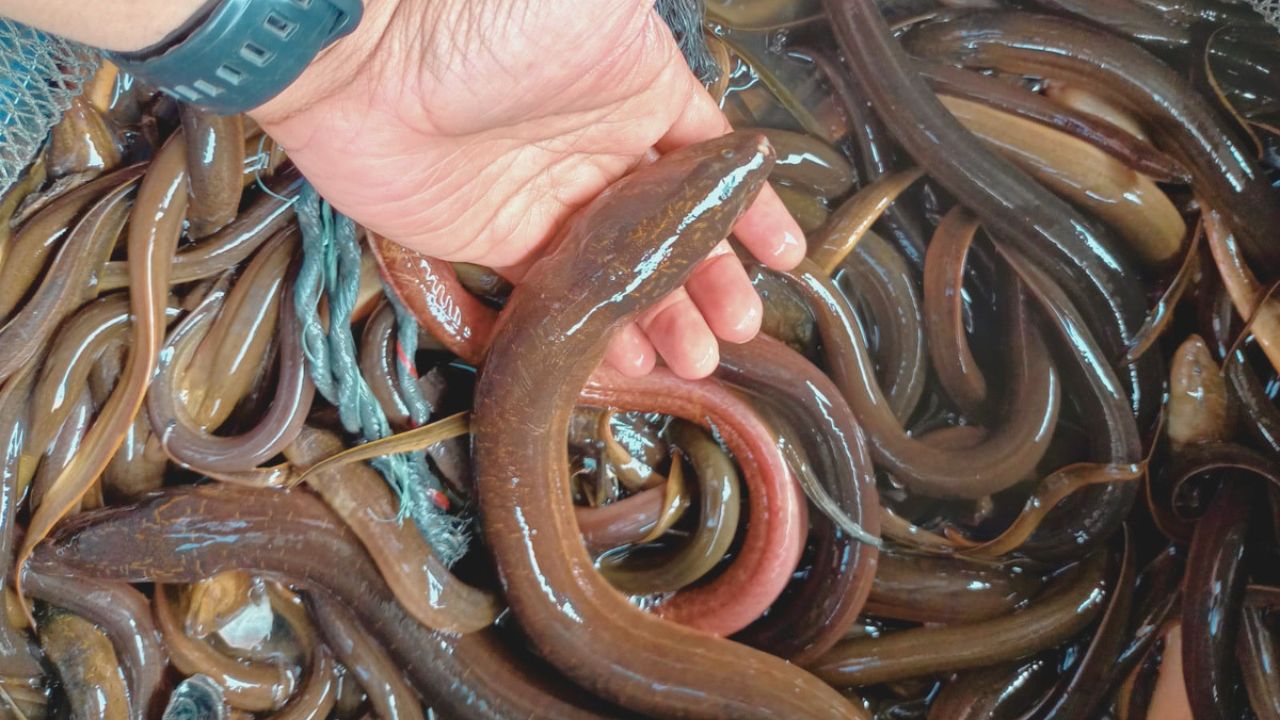

Driven by surging culinary demand across East Asia, Indonesia's wild eels offer lucrative agribusiness prospects, though ecological strains make the transition to sustainable aquaculture increasingly urgent. The eel represents one of Indonesia's freshwater fisheries commodities with a remarkably high economic valuation. Behind a body shape that fundamentally resembles a snake, the eel has transformed into an exclusive agribusiness commodity as the popularity of Unagi-style cuisine continually rises in major markets such as Japan, China, and South Korea.
This growing international demand opens highly promising export opportunities for national farmers, supported by selling prices that tend to remain stable. However, the industry currently faces a wide supply gap between high global market demand and low production yields from the intensive aquaculture sector. Consequently, the vast majority of the national eel supply still relies heavily on wild catches. This deeply rooted dependence triggers profound ecological threats, as the ongoing conversion of rice fields into residential areas and the excessive use of chemical pesticides systematically destroy sensitive mud micro-ecosystems, which in turn drastically reduces the natural eel seed population.
Based on official data from the Ministry of Marine Affairs and Fisheries (KKP), the export of true eels and swamp eels in the first half of 2019 reached 5,186.0 metric tons (11,433,174.5 pounds)—a notable increase from 4,142.0 metric tons (9,131,547.4 pounds) in the previous period—with total export values reaching USD 9.49 million. These crucial exports were overwhelmingly dominated by China with 4,354.0 metric tons (9,598,926.4 pounds) and Hong Kong with 703.0 metric tons (1,549,849.9 pounds). The KKP actively targets the cumulative total value of national fisheries exports to successfully break the USD 6.27 billion mark by 2025. Broad market opportunities for Indonesia remain wide open primarily because local eel species are not currently classified under CITES regulatory restrictions. Even so, the KKP strictly underlines that artificial hatchery technology has not yet been successfully applied on a mass scale, explicitly meaning the essential transition from wild harvesting patterns to sustainable, intensive aquaculture remains an urgent necessity to ultimately preserve original natural ecosystems.
Three eel species in Indonesia
In strict biological taxonomy, eels classified under the Synbranchidae family differ fundamentally from true eels of the Anguilliformes order. The primary morphological difference is the total evolutionary absence of pectoral fins and pelvic fins on the eel, leaving its body perfectly cylindrical without any secondary limbs. Across Indonesia, three main eel species occupy highly specific ecological niches:
Rice Field Eel (Monopterus albus)
This dominant species primarily inhabits rice fields, irrigation canals, ditches, and shallow waters defined by thick mud. It is exceptionally resilient, capable of surviving buried in mud with minimal water availability during long dry seasons. Physically, it is easily distinguished by a yellowish-brown to olive-green dorsal side and a pale yellow ventral side, alongside a distinctly blunt head and sturdy jaw structure. Economically, it overwhelmingly dominates domestic and international markets due to its extraordinary physical endurance during wet transportation procedures.
Swamp Eel (Ophisternon bengalense)
Occupying broader swamp ecosystems, deeper freshwater bodies, and brackish estuarine zones characterized by stable water depths, this specific species features a leaner, more elongated physical posture compared to the rice field eel. Its color tones typically lean toward dark brown, blackish, or solid brown. While its overall commercial value falls below that of the rice field eel, it is increasingly utilized as a vital substitute commodity as wild rice field eel catches continue to rapidly deplete.

Eel catch from the estuary in Muara Muntai District: Luhkan Kab.Kukar/Baiq Sulistyo Rini
Estuary Eel (Macrotrema caligans)
This relatively rare eel thrives in river estuaries and transitional geographical zones between freshwater and seawater heavily influenced by lunar tidal cycles. It uniquely possesses a reddish body color paired with enlarged blood vascularization around the gill area to effectively facilitate necessary salinity tolerance. It is considerably less popular as a large-scale commercial consumption fish, generally functioning merely as traditional incidental bycatch for coastal fishermen.
Biological uniqueness and aquaculture implications
Comprehensively understanding eel biology is crucially important for local farmers to design precise Standard Operating Procedures (SOPs) for aquaculture in order to purposefully minimize severe failure risks.
1. Facultative Air-Breathing
Eels naturally possess an auxiliary respiratory organ in the form of a membrane inside the oral and pharyngeal cavity that is exceptionally rich in blood capillaries, enabling them to absorb atmospheric oxygen directly when water conditions experience hypoxia. The direct implication for farmers is that they do not require high-wattage mechanical aerators to sustain crops. However, pond water depth must be kept strictly shallow, at precisely around 5.0 centimeters (2.0 inches). If water is too deep without physical support structures, the eel will rapidly tire from swimming to the surface to breathe and eventually die from drowning because its primary gill function has undergone evolutionary reduction over time.
2. Protogynous Hermaphroditism
The eel's complex reproductive cycle begins as a female when it is small in size, naturally changing sex to male as body size and physical age increase. The fundamental implication is that artificial hatchery management becomes highly complicated for breeders. Farmers must not exclusively select giant broodstock because it is biologically certain all will be functional males. Operational SOPs explicitly demand asymmetrical broodstock selection: intentionally combining small-to-medium broodstock, which function as females, with a select few large broodstock males inside the spawning pond.
3. Protective Mucus
The eel's scaleless exterior epidermis is completely coated in thick mucus rich in lysozyme enzymes and natural antibodies. This vital mucus functions to maintain internal body moisture during droughts, smoothly lubricates physical movement in mud, and acts as a robust non-specific immune defense. The operational implication is that when the eel is stressed by sudden shocks or high density, dermal skin glands will invariably experience mucus hypersecretion. Dissolved mucus in the water will then decay rapidly, instantly increase Biological Oxygen Demand (BOD), and frequently trigger aerobic bacterial infections. Required transportation SOPs demand intentionally lowering water temperatures utilizing ice to provide mild clinical anesthesia, which successfully inhibits mucus secretion during long-distance shipping routes.
Economic value and culinary export landscape
The premium nutritional profile of eel meat effectively makes it a modern superfood, explicitly containing high protein, iron, phosphorus, vitamins A and B, plus essential fatty acids EPA and DHA, which are highly beneficial for sustaining human brain and cardiovascular health. Within the domestic market, local micro, small, and medium enterprises (MSMEs) process fresh eel into high-value culinary products:
Surabaya's signature dry fried eel is commercially produced utilizing deep-frying techniques infused with traditional local spices, subsequently creating a crispy, savory texture highly popular across East Java. Conversely, Yogyakarta's Godean eel chips explicitly utilize undersized eels to successfully drive the independent local economy for hundreds of dedicated Sleman artisans. Additionally, Central Java's signature mangut belut is a famously spicy coconut milk stew actively utilizing traditional smoked eel currently favored in diverse domestic markets.

Eel chip production at the processing facility owned by Mrs. Sunarsih in Danguran Village, South Klaten District: Luhkan Kab.Klaten/Octasari Wijayanti
For the lucrative export market, Indonesian eels are highly demanded by prosperous East Asian countries such as Japan, China, and South Korea. Amuntai, located in South Kalimantan, represents a remarkably significant live export production center. Wild-caught swamp eels from the Hulu Sungai area are systematically collected primarily because they physically possess remarkably strong endurance for high-altitude air freight. Through this robust commercial activity, local rural farmers can consistently reap revenues ranging between Rp 75.0 million and Rp 85.0 million per harvest period.
Prominent exporters like CV Tiga A actively purchase super-quality rice field eels directly from local collectors at Rp 30,000.0 per kilogram (2.2 pounds) and sell them to destination countries with final landing prices routinely reaching Rp 100,000.0 per kilogram (2.2 pounds). Based strictly on South Kalimantan Quarantine data compiled since March 2024, 11 individual live shipments to China have been securely recorded, successfully accumulating a total volume of 264,678.0 individual eels with an impressive economic value reaching Rp 2.4 billion. During one documented export dispatch executed by CV Tiga A via Syamsudin Noor International Airport, 27,900.0 live eels—weighing approximately 2,016.0 kilograms (4,444.5 pounds) or 2.0 metric tons—were sent directly to China using Garuda Indonesia airlines, successfully generating foreign exchange value reaching USD 9,678.8. Before authorized dispatch, all live eels must rigorously pass clinical and laboratory tests ensuring they remain completely free from Gnathostoma parasites and Aphanomyces invadans fungi, which directly causes Epizootic Ulcerative Syndrome (EUS), in order to secure a mandatory Health Certificate (KI-D1).
Eel aquaculture challenges and ecological solutions
Despite highly stable commodity selling prices, intensive eel aquaculture continuously faces five complex biological and technical operational challenges:
1. Dependence on wild seeds and quarantine
The total industry absence of seed supply from modern commercial hatcheries forces farmers to completely depend on wild catches. The extensive use of electrofishing equipment by unregulated eel hunters inherently triggers latent internal organ damage, which ultimately leads to disastrous mass mortality reaching 90 percent in commercial grow-out ponds. The vital SOP that must be rigorously enforced is strictly filtering the physical condition of seeds and conducting formal quarantine for at least 7 to 14 days, directly providing mild aquatic antiseptics like fish salt or herbal extracts to properly neutralize pathogens before stocking into the main pond.
2. Pellet adaptation and transitional feed management
Eels exist as obligate carnivores that instinctively prey exclusively on moving, live food. Providing dry commercial pellets directly will invariably trigger sudden mass hunger strikes. The scientific solution is to carefully train the eels utilizing olfactory engineering techniques. Dedicated farmers must physically mix a paste feed consisting of chopped natural feed, such as earthworms or golden snails, directly combined with commercial pellet flour, then subsequently spray it with fish oil attractants gradually over a 2 to 3 week transitional adaptation period.
3. Mud media engineering and water toxicity
The primary natural habitat of local eels is mud. In standard tarpaulin ponds measuring 400.0 by 200.0 centimeters (157.5 by 78.7 inches) or durable concrete ponds measuring 500.0 by 500.0 centimeters (196.9 by 196.9 inches), raw organic media is carefully layered. This vital substrate directly includes straw measuring 25.0 to 40.0 centimeters (9.8 to 15.7 inches), raw manure, compost, chopped banana stems measuring 10.0 centimeters (3.9 inches), natural mud soil, and finally water at a specific height of 5.0 centimeters (2.0 inches). The subsequent anaerobic decomposition reaction of these raw organic materials naturally produces accumulations of highly dangerous gases, specifically ammonia (NH₃) and hydrogen sulfide (H₂S), which are inherently neurotoxic and physically damage the gills. The proven ecological solution involves deliberately fermenting the media using decomposer probiotics for 14 to 30 days until emerging gas bubbles no longer emit a pungent odor.

4. Cannibalism due to starvation or size asymmetry
As natural aquatic predators, eels will aggressively cannibalize each other if routine feeding is moderately delayed. Furthermore, the biological phenomenon of protogynous hermaphroditism naturally makes male individuals grow significantly bulkier and inherently more aggressive compared to females. This extreme physical size disparity inherently triggers devastating mass cannibalism. Effective mitigation practically entails conducting routine physical grading every 3 to 4 weeks to thoroughly group eels based entirely on uniform sizes, alongside deliberately installing basic paralon pipes to serve as necessary environmental shelter.
5. Pathogen threats and stress
Drastic environmental temperature changes can easily erode the eel's vital protective mucus layer, rapidly inviting secondary infections from the gram-negative bacteria Aeromonas hydrophila, which tragically causes Motile Aeromonad Septicemia (MAS). Visual symptoms prominently include actively bloody skin ulcers and severely rotting fins. The primary ecological solution involves deliberately using biological control agents, specifically the robust antagonist bacteria Pseudomonas sp., actively dispersed into the commercial pond to directly compete with local pathogens. Additionally, strategically providing phytobiotics such as pure black cumin (Nigella sativa) extract directly inside the feed has been medically proven to significantly strengthen the eel's overall immune system.
Successfully developing the domestic eel commodity in Indonesia actively presents brilliant international export economic prospects, yet its overall long-term success is heavily determined by permanently transitioning from destructive wild harvesting methods directly to environmentally friendly, fully controlled intensive aquaculture systems. Total operational mastery of unique biological aspects—such as critical facultative breathing, protogynous hermaphroditism, and vital mucus secretion—must be systematically converted directly into precise, scientific grow-out operational standards. By expertly controlling the severe toxicity of ammonia (NH₃) and hydrogen sulfide (H₂S) during mud media fermentation, thoroughly mitigating cannibalism through periodic size grading, and vastly enhancing biological biosecurity against Aeromonas hydrophila septicemia outbreaks, Indonesia currently possesses the fundamental ecological capital to firmly secure the broader global supply chain without irreparably damaging the archipelago's precious original ecological wild populations.