
The Covid-19 pandemic has dealt a devastating blow to many business sectors around the world, triggering fundamental changes in the global economic landscape. However, in the midst of the challenges that have hit, the fisheries sector has emerged as one that shows extraordinary resilience. In fact, this sector has managed to experience rapid recovery, proving that the potential of the fishing industry continues to shine amidst the economic crisis.
One of the highlights of this potential is the cultivation of pangasius, which is often known as "dori" in the modern market. Pangasius, as a type of freshwater fish, has great potential for further development, both for domestic consumption and for export. However, behind this potential, there are still various challenges that need to be overcome.
One of the main challenges is the selling price which is often low, resulting in a lack of incentives for farmers to develop pangasius cultivation to its maximum potential. Apart from that, the use of technology, especially in terms of marketing fishery products through e-commerce, is still not fully maximized.
Covid-19 Pandemic; challenges and opportunities
The impact of the Covid-19 pandemic on the fisheries sector has been in the spotlight, with a significant decline in export demand and delays in supply due to imposed transport restrictions. This condition poses a serious challenge for fisheries industry players throughout the world, considering that most fishery products are perishable and require a smooth supply chain.
However, despite facing severe challenges, the fisheries sector has shown extraordinary resilience and even experienced a rapid recovery. This cannot be separated from the strategic role of the fisheries sector as a vital food provider for society. Demand for fishery products remains high amidst the pandemic, because the need for animal protein remains a priority for consumers.
Data released by the Central Statistics Agency (BPS) in 2021 shows that the fisheries sector has a significant contribution to Indonesia's Gross Domestic Product (GDP). In the second quarter, the GDP value of the fisheries sector reached IDR 188 trillion, which is equivalent to 2.83 percent of the total national GDP value. This development marks an increase compared to the previous quarter which reached IDR 109.9 trillion or 2.77 percent of the national GDP value. This increase provides concrete evidence that the fisheries sector is not only able to survive in the midst of a global pandemic, but is also able to grow and contribute positively to the country's economy.
With its rapid recovery and significant contribution to GDP, the fisheries sector has proven itself to be a vital and resilient sector in difficult times like this pandemic. The success of the fisheries sector in facing these challenges also shows the importance of continuing to develop strategies and innovations in order to strengthen food security and the country's economy as a whole.
The potential of pangasius as a driver of the local economy

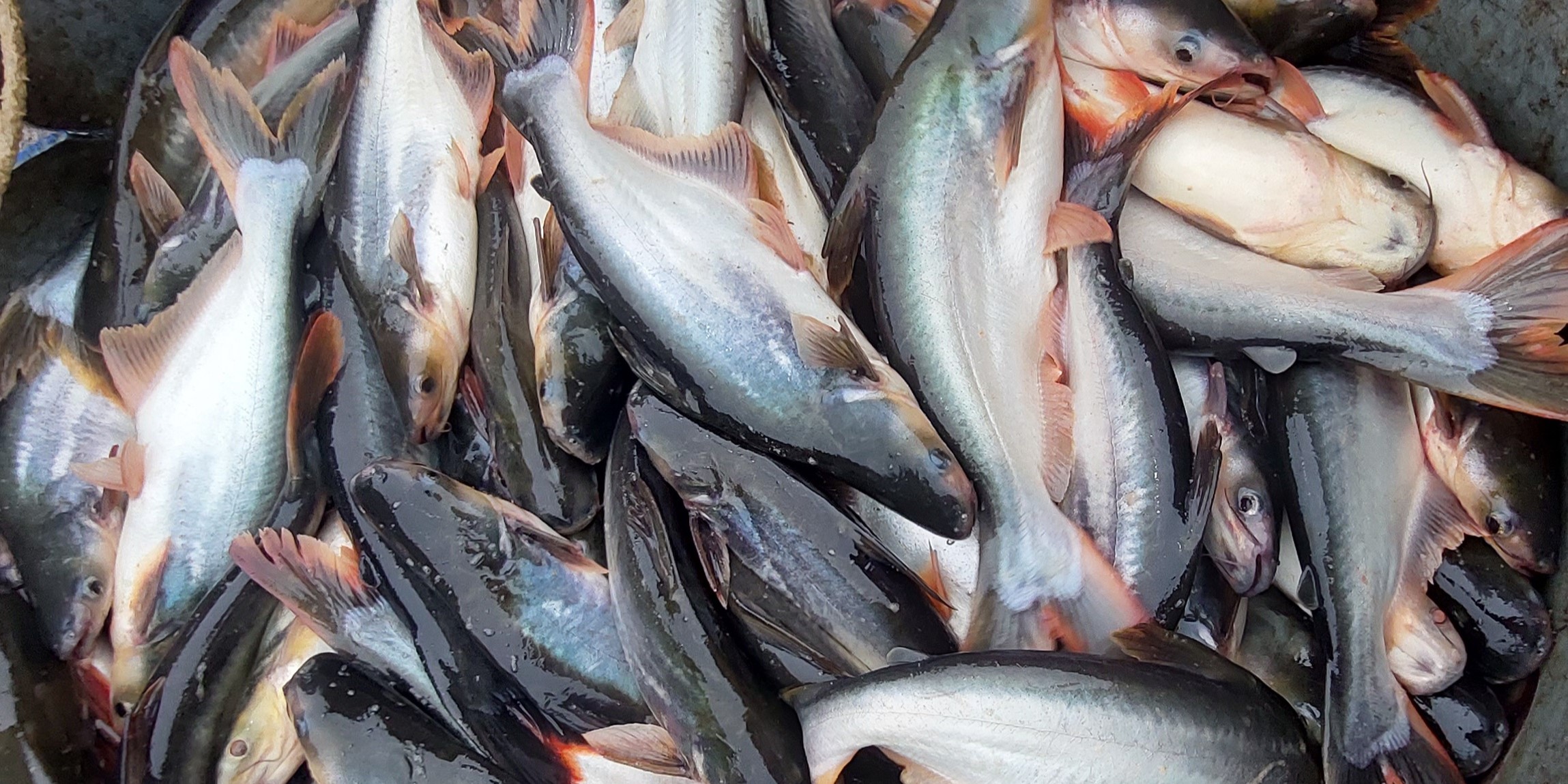
Results of the pangasius harvest in Kampung Patin, Riau at the event field trip
Pangasius, as one of Indonesia's leading fisheries commodities, offers great potential as a high-value food source. Known for its soft, delicious and slightly spiny flesh texture, this fish has become a favorite choice on many families' dinner tables. However, amidst such promising potential, the selling price of pangasius often declines, facing serious challenges in becoming a priority for public consumption.
To overcome this problem, steps to control the selling price of pangasius are very important. Continuous efforts are needed to ensure that the selling price reflects the true value of this product, while ensuring fairness and balance in the distribution of added value in the fisheries supply chain.
One solution that has emerged as an answer to this challenge is through utilization e-commerce in marketing fishery products, including pangasius. By utilizing the platforme-commerce, pangasius producers and breeders can cut long marketing chains and reduce dependence on middlemen or intermediaries. This can provide direct benefits for producers in terms of price control and increased profits.
In contexte-commerce, pangasius can be marketed directly to consumers via online platforms, without going through traditional distributor networks. In this way, additional costs that typically occur in traditional supply chains can be reduced, allowing sales at more competitive prices for cultivators.
Apart from that, utilization-commerce also allows pangasius producers to reach a wider market, both domestically and internationally. Through online platforms, pangasius products can be sold directly to consumers in various cities and countries without being limited by geographical boundaries. This opens up new opportunities for pangasius farmers to increase their competitiveness and get better prices for their products.
Utilization e-commerce in pangasius marketing
Although e-commerce has become an integral part of daily life, especially in the post-pandemic era, its utilization in the fisheries sector is still not fully optimal. This is a wide open opportunity to optimize the marketing of fishery products, including pangasius, through the platforme-commerce.
Marketing pangasius through e-commerce has great potential to reduce dependence on middlemen and cut long marketing chains. By using e-commerce, cultivators and producers can sell their products directly to consumers without having to go through a long distribution network. This not only reduces additional costs in the supply chain, but also provides greater control over the selling price of the product.
Marketing pangasius through e-commerce is also very relevant in facing post-pandemic challenges. In conditions where consumers tend to avoid physical contact and prefer to shop online, utilization e-commerce becomes more important than ever. By utilizing the platforme-commerce, producer pangasius can maintain their market access even amidst uncertain situations.
However, to be successful in marketing pangasius through e-commerce, good cultivation quality and proper post-harvest handling are also key. Fresh fish products will have a high selling value if they are packaged well and marketed effectively. Therefore, there is a need to digitize the entire supply chain of fishery products, from cultivation to marketing, in order to ensure optimal product quality and increased added value.
Digital transformation at the village level

Kampung Patin, a local village that offers various processed pangasius
Development of pangasius through e-commerce is an opportunity that can not only provide economic benefits for cultivators in rural areas, but can also produce broad positive impacts on economic development at the local level. In this context, village fund programs can be an effective instrument to support this initiative.
To realize this potential, digital transformation at the village level becomes very important. Village organizations, in collaboration with the village government, need to make efforts to digitize the marketing of the community's flagship products, including pangasius. Concrete steps, such as training in the use of digital technology, building digital infrastructure, and providing affordable internet access, need to be taken to ensure that village communities can take advantage of e-commerce effectively.
By involving many village communities and supporting them with adequate digital infrastructure, marketing pangasius through e-commerce can be more effective and efficient. By utilizing the platforme-commerce, cultivator pangasius can sell their products directly to consumers, without going through intermediaries who eat into profit margins. This will help increase cultivator income and ensure good market absorption for the product pangasius.
Additionally, developing pangasius through e-commerce can also open up new opportunities for cultivators to enter wider markets, including international markets. By utilizing the platforme-commerce, pangasius not only can be sold locally, but it can also be accessed by consumers in various countries. This will help increase product competitiveness in the global market and increase the country's export earnings.
Conclusion
Fish pours, as one of Indonesia's leading fisheries commodities, has great potential to become a significant driving force for the local economy. However, to realize this potential, collective efforts from various parties are needed to overcome the various challenges faced, especially related to low selling prices and lack of utilization.e-commerce in marketing fishery products.
First of all, the government needs to play an active role in providing policy and infrastructure support that supports industrial development of pangasius. This includes providing incentives and facilities for cultivators and producers of pangasius, as well as ensuring clear and sustainable regulations to regulate selling prices and product quality standards.
Business actors, including cultivators, producers and traders pangasius, also need to play an active role in increasing the added value of products and optimizing marketing through e-commerce. This can be done by improving production processes, post-harvest handling and more effective marketing strategies.
Village communities also have an important role in the development of pangasius. Through active participation in local economic development programs, rural communities can help strengthen supply chain pangasius, improve product quality, and promote marketing through e-commerce.
The use of digital technology, in particular-commerce, is the key to optimizing marketing pangasius. By utilizing the platforme-commerce, cultivators and producers of pangasius can sell their products directly to consumers, bypassing long distribution chains, and increasing profits.