
The landscape of Namibia presents a spatial contrast that distinguishes it from the majority of coastal nations in the world. With a land area exceeding 823,000 square kilometers (317,762.1 square miles), this territory is dominated by the hyper-arid solitude of the Namib Desert, making it one of the regions with the lowest population densities in Sub-Saharan Africa. This precipitation-scarce expanse of sand directly borders the cold waters of the Atlantic Ocean, creating a coastline that has historically appeared unwelcoming to both human settlement and traditional agricultural activities. However, viewed through the lens of spatial analysis and international logistics, this exact lack of a dense coastal population provides a blank canvas for the state to construct precisely calibrated maritime infrastructure, transforming extreme remoteness into a center of logistical gravity.
The epicenter of this economic orchestration lies in Walvis Bay, a natural deep-water port that has evolved into the central artery of trade for the southern region of the African continent. The Namport port authority designed this facility not merely as a loading and unloading point for domestic commodities, but rather as a strategic logistical gateway connecting the landlocked countries within the Southern African Development Community (SADC) bloc to global trade routes. This commitment to supply chain efficiency was materialized through a 40-hectare (98.8-acre) reclamation megaproject that absorbed billions of dollars in investment. This new infrastructure includes the addition of a 600-meter (1,968.5-foot) quay wall and the installation of high-capacity ship-to-shore cranes, which collectively boost the container terminal's capacity from 350,000 TEU to 750,000 TEU per year. This structural capacity enhancement was aligned with the integration of a cutting-edge cold chain system to facilitate the export of high-value seafood products.
The competitiveness of Walvis Bay rests upon its operational speed and the efficiency of vessel turnaround time. Container ships docking at this port generally complete the loading and unloading process within a span of 24 to 48 hours. This performance contrasts starkly with the volatility that frequently afflicts regional competitor ports such as the Port of Durban in South Africa, which handles up to 4.5 million TEU per year yet often experiences berthing delays lasting for days as a result of operational congestion. This maritime efficiency at Walvis Bay is subsequently integrated with overland transportation arteries such as the Trans-Kalahari Corridor and the Trans-Cunene Corridor. These land routes cut logistical travel distances by 400 kilometers (248.5 miles) compared to traditional routes leading to the industrial center in Gauteng, providing a more predictable and cost-efficient alternative for the mining and industrial sectors in Botswana, Zambia, and Zimbabwe. Thus, Namibia has successfully bridged its geographic paradox, managing a desolate landmass that is nonetheless sustained by an industrialized maritime facility system that pumps the economic pulse of the region.
The Benguela machine, toxic eruptions, and extreme resilience
The logistical prosperity in Walvis Bay does not stand alone; this human-made infrastructure rests upon a massive natural oceanographic dynamic, namely the Benguela Current System. This marine circulation phenomenon acts as a thermodynamic upwelling machine that constantly pumps cold water masses from the depths of the pelagic zone to the surface. This deep water mass carries an abundant concentration of macro-nutrients in the form of nitrates, phosphates, and silicates, triggering the exponential growth of phytoplankton in the photic layer. The availability of this foundational feed creates one of the most biomass-dense marine food webs in global waters. However, this high level of primary productivity carries deadly biochemical consequences. Millions of tons of residual organic biomass and dead phytoplankton ultimately settle on the continental seabed. The decomposition process of this biomass drains the majority of dissolved oxygen, creating a bottom-water zone that experiences severe hypoxic conditions.
Amidst these oxygen-deprived conditions, anaerobic microorganisms, including sulfate-reducing bacteria from the SUP05 clade, take over the metabolic decomposition process. These bacteria release highly corrosive hydrogen sulfide (H₂S) gas into the diatom mud sediment layer. Sporadically, this accumulation of methane and hydrogen sulfide gas erupts from the seabed toward the water's surface. This toxic gas eruption frequently changes the color of coastal waters to a milky turquoise, a sulfide oxidation reaction that can be clearly monitored through satellite imaging instruments such as MERIS and SeaWiFS. This geochemical event is highly lethal to the majority of pelagic marine organisms, frequently triggering the mass mortality of commercial fish populations and forcibly simplifying the ecosystem structure.
Within this oppressive and toxin-laden environment, the Benguela ecosystem is saved by the extreme physiological adaptation of an endemic fish known as the bearded goby (Sufflogobius bibarbatus). Following the collapse of the pelagic sardine population in the 1970s due to overexploitation, the food web system was threatened to break, becoming dominated by jellyfish and benthic microbes. However, the bearded goby emerged as an intermediary species that elegantly prevented the ecological collapse of Benguela. This small-sized fish developed an unusual tolerance to oxygen-depleted conditions and high-level hydrogen sulfide exposure. Enzymological and biochemical analyses of their muscle tissue revealed that the bearded goby relies on anaerobic metabolic pathways to survive, as evidenced by the accumulation of lactic acid and specific enzyme ratios that indicate resilience to hypoxia even from the larval stage. This adaptation allows them to dive and settle passively within the toxic mud flats for a dozen hours during the day, a strategy that effectively protects them from the threat of pelagic visual predators.
This resilience transcends a mere survival mechanism; it acts as a biological recycling engine. When night falls and the risk of predation decreases, the bearded goby migrates vertically into the upper water column to forage. Their primary prey includes diatom mud on the seabed and Chrysaora fulgida, a jellyfish species whose population has surged rapidly. Because jellyfish generally have low nutritional content, many species treat them as an ecological dead end. Yet, by consuming these gelatinous organisms, the bearded goby successfully converts unutilized organic matter into calorie-dense structural proteins. In turn, this goby population becomes the primary energy source for high-level commercial predators such as hake, as well as supporting the lives of coastal predators like Cape fur seals and endemic seabirds. The presence of the bearded goby ensures that the ecosystem's energy chain remains fully intact despite operating under an extreme geochemical regime.

A colony of Cape fur seals gathered on a beach in Namibia: Wikimedia Commons/flowcomm | CC BY 2.0 (Modified)
Extraction governance, msc, and the doctrine of Namibianization
The biological energy dynamics sustained by the goby ultimately culminate in a highly valuable commercial extractive industry structure. The history of Namibian fisheries prior to its independence in 1990 was colored by boundless exploitation by distant-water fleets that drained the fish reserves in the Benguela region. Recognizing this vulnerability, the current transition from a biological food chain to economic capitalism is guarded by bureaucratic firmness and scientific discipline through the implementation of the Marine Resources Act of 2000. This regulation mandates relevant agencies to place independent fisheries observers on fishing fleets, ensuring compliance with conservation instruments in real-time.
The backbone of Namibia's capture fisheries revenue centers on the demersal extraction of hake—which consists of shallow-water hake (Merluccius capensis) and deep-water hake (Merluccius paradoxus)—as well as horse mackerel species in the pelagic zone. The state strictly enforces a Total Allowable Catch (TAC) system formulated through annual stock surveys and biomass estimation models. This commitment to the precautionary principle yielded a significant international achievement; in 2020, the Namibian hake bottom trawl and longline fisheries sector officially achieved prestigious certification from the Marine Stewardship Council (MSC). This certification established Namibia as a pioneer nation in Africa for sustainable hake commodities, and it recently succeeded in maintaining this status through a rigorous audit process during its second certification cycle. This MSC standard is highly essential because the blue label acts as a trading passport for Namibian hake fillets to penetrate premium retail markets in Europe that are highly sensitive to ecological issues.
This governance does not solely focus on extraction volume, but also on the mitigation of non-targeted species interaction (bycatch). The Namibian hake industry responded to reports of high mortality rates among hooked seabirds by mandating the installation of tori lines, or bird-scaring lines, across all longline and trawl fleets. This simple technical implementation, consisting of colored ribbons trailing behind the vessel, has empirically managed to suppress the death rate of vulnerable species, including albatrosses, blending commercial rationality with wildlife protection ethics.
Furthermore, the essence of this resource sovereignty is fully encapsulated in a policy known as the doctrine of "Namibianization." The government does not wish to repeat the mistakes of other developing nations that export their natural resources as raw commodities. Consequently, the state implemented a structural mandate forcing at least 85 percent of the total commercial catch to be landed and processed at processing facilities or fillet factories situated on the Namibian mainland coast prior to obtaining export permits. This protectionist intervention is systematically designed to prevent capital leakage abroad and to embed value addition within the domestic economy. The implications of this policy are highly tangible; fleet operations and the network of processing plants in Walvis Bay and Lüderitz currently protect at least 16,000 direct jobs for the local workforce. This onshore processing policy also possesses a dimension of social justice, where the majority of workers absorbed in the cutting and packaging production lines are women from coastal communities, making this marine sector a contributor of up to seven percent to the nation's Gross Domestic Product (GDP).
Two-faced aquaculture, Atlantic oysters and the inland oasis
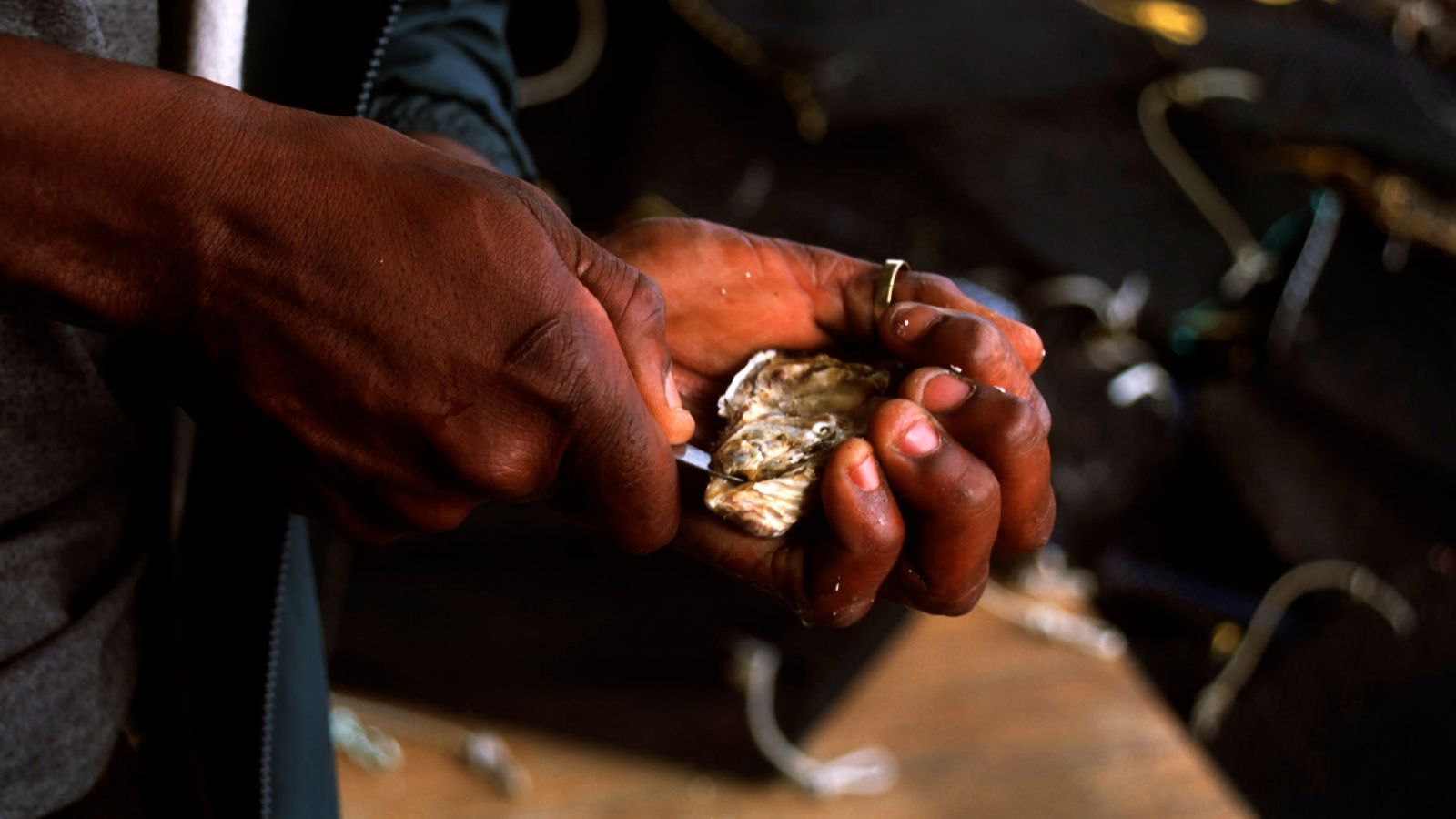
This disciplined marine spatial architecture also sows the foundation for the aquaculture sector, which demonstrates a sharp operational dichotomy: coastal maritime productivity versus the challenge of freshwater availability in the northern inland. In its first face, the sheltered waters in the coastal areas of Walvis Bay and Lüderitz offer a natural comparative advantage for the development of bivalve mariculture. The constant effect of the Benguela Current System, which provides a ceaseless supply of nutrients and phytoplankton, creates a biological anomaly that is beneficial for the cultivation of Pacific oysters (Crassostrea gigas).

Harvesting activities at an oyster farming facility in Walvis Bay, Namibia, known for its fresh oysters: Wikimedia Commons/Olga Ernst | CC BY-SA 4.0 (Modified)
This nutrient-rich circulation of natural feed enables oyster commodities in Namibia to reach commercial harvest size parameters in just 8 to 10 months from the seed phase. This growth acceleration disrupts global industry standards; in most northern hemisphere waters, such as the coastal regions of Europe, the oyster grow-out cycle requires a duration stretching between 18 to 36 months. This vastly abbreviated harvest speed mitigates the majority of long-term operational risks, such as disease exposure or ocean storms, while simultaneously accelerating cash flow turnover for business operators. This level of efficiency positions Namibia as a premium supplier for the high-caliber live oyster market in the Asian and South African regions, converting the pelagic nutrient supply into a highly profitable mariculture investment instrument.

Workers at the Luderitz Mariculture oyster farm in Namibia sorting oysters into mesh bags before they are shipped to meet market demands in South Africa: FAO/M. Namundjebo | Editorial use only (Modified)
In contrast to the established mariculture of Walvis Bay, the second face of Namibian aquaculture materializes in the northern inland region, a territory hydrologically besieged by limited freshwater and sporadic rainfall. For the government, the development of inland fisheries in this region is not oriented solely toward commercial export, but rather toward building subsistence food security and generating an independent protein source for vulnerable agricultural communities. Leveraging existing water supply networks, the government, through the Ministry of Fisheries and Marine Resources, constructed integrated research and hatchery facilities, such as the Onavivi Inland Aquaculture Center (IAC). This strategic facility is dedicated to cultivating species with high resilience to extreme climate fluctuations, particularly varieties of Tilapia and African catfish. The Onavivi Center not only produces seeds for community farmers but also transfers agribusiness operational technical knowledge.
However, the transition of rural communities into aquaculture encounters a primary hurdle in variable cost structures. The procurement of commercial pelleted fish feed, the vast majority of which is imported, drains approximately 70 percent of total operational costs for small-scale farmers, a margin that leaves local production vulnerable to global price fluctuations. To neutralize this economic pressure, local researchers designed alternative feed solutions by adopting base ingredients from local agricultural waste. This daily nutritional formulation incorporates the integration of wheat bran, maize cake, and pearl millet, known by the local community as mahangu. This innovative feed formulation based on post-harvest waste has been empirically proven capable of drastically suppressing maintenance input costs, up to half of the base price of imported feed. This supply chain integration between the terrestrial agricultural sector and aquaculture brings a functional food security oasis to life, ensuring the survival of small businesses in even the most arid regions.
Seismic threats and the promise of a circular economy
Despite the stability of the fisheries architecture that has been established, the sustainability of Namibia’s blue economy is not exempt from contemporary pressures stemming from marine spatial competition and global climate transformation. The most significant threat arises from the escalation of offshore mineral and fossil energy extraction proposals, specifically oil and gas industry seismic survey projects alongside seabed phosphate mining plans. Seismic exploration operations function by emitting massive-strength acoustic wave pulses, which frequently reach an intensity of 260 decibels. This high-powered, low-frequency dispersion has the potential to cause navigational disorientation in marine mammal species, disrupt the cellular development phase of fish larvae, and disturb the biomass movement patterns that are crucial for commercial trawl fleets. On the other hand, phosphate mining projects demand the dredging of millions of tons of basal sediment per year, a mechanical exploitation process that carries the risk of displacing natural spawning substrates for hake and resuspending heavy metal and sulfide deposits back into the sensitive water column. This pressure is further exacerbated by the slow threat of climate change, which has the potential to trigger further marine deoxygenation, expanding hypoxic areas and thereby restricting the regeneration space of keystone species within the Benguela ecosystem.

Offshore oil platform at Cape Cross, a Cape seal reserve located near Walvis Bay, Namibia: Commons/Buiobuione | CC BY-SA 4.0 (Modified)
Facing the paradox of overlapping threats between industrial advancement and habitat degradation, Namibian fisheries stakeholders formulated a proactive defense strategy through the application of a circular economy model. This concept was made concrete through the launch of the Namibia Ocean Cluster initiative in the first half of 2024, a non-profit partnership consortium mediated by the World Economic Forum framework. This cluster was initiated by six of the largest integrated hake fishing corporations in the country, encompassing major entities such as Hangana Seafood, Seawork, Novanam, Merlus, and Pereira. Instead of operating separately as competitors, these companies agreed to adopt the principle of waste deconstruction, inspired by the success of the 100 percent Fish Program from the Nordic region of Iceland.
Operationally, this circular initiative targets fish cutting residues—such as heads, bones, skin, and viscera—that were previously viewed as a low-value waste burden. The cluster develops research and technological markets to convert this discarded fisheries biomass into a variety of downstream commodities with far higher economic value. Processing residues from fillet factories on the coast of Walvis Bay are processed into bioactive materials like marine collagen, gelatin, protein concentrates, and nutrient-rich fish feed raw materials. The implementation of this circular supply chain model indirectly bridges the duality of Namibian aquaculture; cheap protein waste from the coast can be channeled inland to lower the production costs of freshwater fish farming in the northern territories. This integrated initiative drastically minimizes the caloric loss of natural resources, ensuring that every metric ton of fish extracted from vulnerable waters is fully utilized economically, without the need to increase the fleet's pressure level at sea.
For a massive-scale maritime nation like Indonesia, the analysis of Namibia's marine governance presents a developmental paradigm worthy of close observation. Extreme geographical remoteness and geochemical anomalies such as toxic gas eruptions prove that natural barriers can be mitigated. Namibia has successfully instituted a bureaucracy strictly grounded in scientific compliance, designed port logistics facilities that do not compromise on inefficiency, and established firm limits on resource extraction through quota management and sustainable certification. This nation proves that the protection of local employment through onshore marine processing laws, combined with zero-waste cross-industry innovation, is the necessary method to translate economic sovereignty from paper into tangible and sustainable prosperity. A true blue economy, as demonstrated by Namibia, is not about exploiting the ocean as massively as possible, but rather about extracting maximal value from every single gram of maritime resources that natural ecological boundaries have permitted.



.jpg)
.jpg)