
The Republic of Cameroon currently faces a critical economic paradox within its food security sector. Despite abundant hydrographic potential and a strategic coastline along the Gulf of Guinea, the nation suffers from a severe structural imbalance in its domestic animal protein supply. With national demand for fishery products exceeding 400,000 metric tons annually and domestic production stalling at 241,561 metric tons, the country grapples with a structural supply deficit of over 160,000 metric tons per year. This gap forces a reliance on global markets, draining 231.6 billion XAF (approximately 380 million USD) in foreign exchange reserves annually to import over 260,000 metric tons of frozen fish, exposing the nation to severe supply chain and currency volatility.
To address this, the Government of Cameroon has integrated import substitution as a primary pillar of its National Development Strategy 2020–2030 (SND30). Under the Ministry of Livestock, Fisheries, and Animal Industries (MINEPIA), the state targets doubling aquaculture production to 25,000 metric tons by 2027 and reaching 50,000 metric tons by 2030. This institutional commitment is bolstered by external capital through the Livestock and Fisheries Value Chain Development Project (PD-CVEP), funded by the African Development Bank (AfDB) for 84 million EUR.

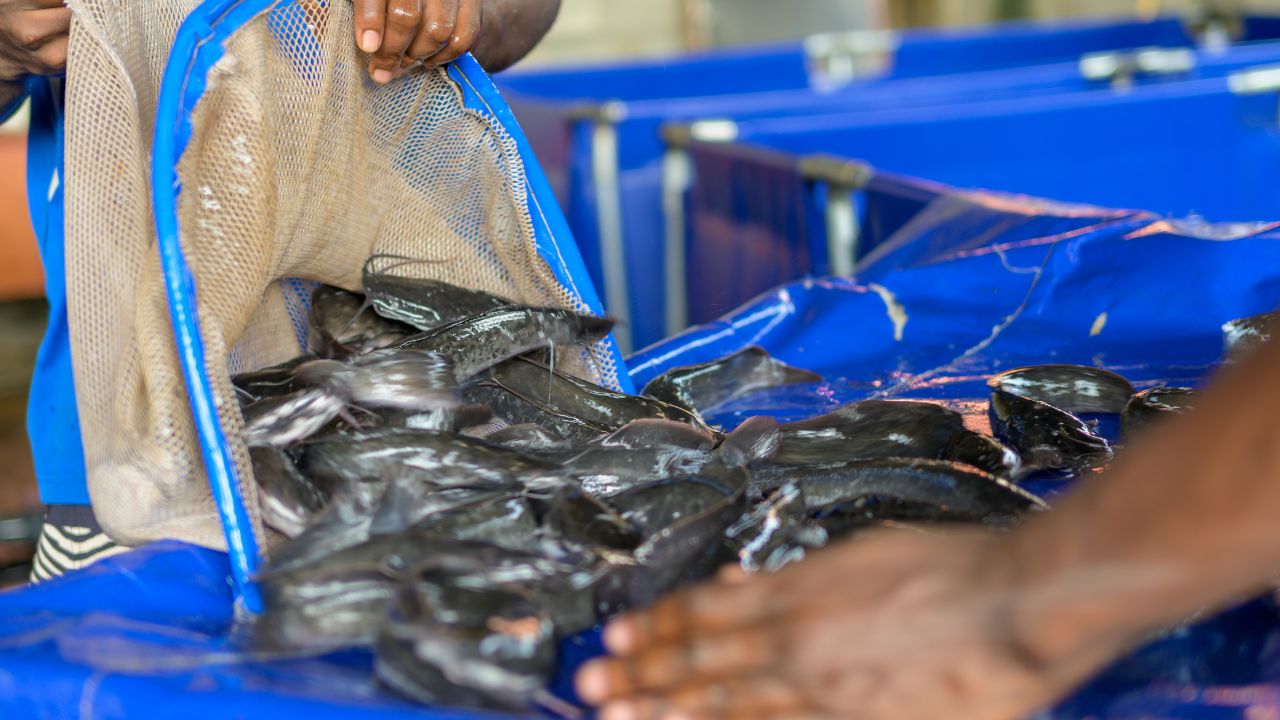
A view of a catfish farming pond in Yaoundé, Cameroon: Wikimedia Commons/Franco237
Raw material sovereignty as a driver of profitability
The most fundamental barrier preventing Cameroon’s aquaculture sector from transitioning to industrialization is the "feed cost trap". In aquaculture economics, feed accounts for the largest portion of the Cost of Goods Sold (COGS).
Analysis reveals the price of imported commercial feed ranges from 1,200 XAF to 1,600 XAF per kilogram (2.2 pounds). Under this price structure, feed absorbs 50 to 70 percent of operating costs, leaving farmers with razor-thin margins when competing against significantly cheaper imported frozen mackerel. Traditional farmers attempting to bypass these costs often fall into the trap of low stocking densities (3 to 5 fish per cubic meter), failing to achieve economies of scale.
A strategic solution is the creation of local feed sovereignty through raw material import substitution. Based on recent aquaculture incubator case studies, transferring extruder machine technology with a capacity of 100 to 150 kilograms per hour (220.5 to 330.7 pounds per hour) has proven to be a turning point for profitability. Extrusion utilizes high heat and pressure to achieve starch gelatinization, producing floating feed pellets that are easily digested by Tilapia (Oreochromis niloticus), while preventing water pollution from sinking, wasted feed.
Efficiency in production costs is achieved by formulating domestic agricultural commodities to substitute expensive fishmeal. These local formulations maximize cottonseed cake, sourced from northern Cameroon via entities like Sodecotton. While requiring careful formulation management due to gossypol's anti-nutritional content, it provides a highly economical plant protein source. Furthermore, soybean meal and corn bran, domestically abundant agricultural derivatives, are utilized to balance amino acid profiles and provide base energy.
By localizing the feed supply chain, extruded feed production costs can be dramatically reduced to between 500 XAF and 700 XAF per kilogram.

A roadmap for diversification across three ecoregion zones
Achieving SND30 targets cannot be realized through a uniform spatial approach; it requires mapping environmental carrying capacity, logistical infrastructure, and species commodity profiles. Cameroon’s aquaculture roadmap rests on diversifying three geographic zones with specific economic mandates.
1. Peri-urban zone (Yaoundé): biofloc technology incubators
The peri-urban areas around Yaoundé face land constraints but offer absolute logistical advantages due to their location near consumer markets. This zone is designed as a "Technology Incubator" utilizing Biofloc Technology (BFT) to maximize yields on limited land.
BFT is an intensive, zero-water-exchange system that manipulates the carbon-nitrogen (C:N) ratio. With external carbon sources, heterotrophic bacteria convert toxic ammonia waste into protein flocs subsequently consumed by fish. Macro-advantages include extreme intensification, exponentially increasing stocking density to 30 to 50 kilograms per cubic meter. Tilapia's ability to consume bioflocs directly reduces the Feed Conversion Ratio (FCR) to approximately 1.2 to 1.3, bridging feed inefficiency gaps. Additionally, isolation from open water protects superior genetic broodstock from wild pathogens.
2. Inland river water zones (Dibamba & Nyong): commercial expansion scalability
To reach targets involving tens of thousands of metric tons, Cameroon must exploit major rivers using Floating Net Cages (KJA), where natural water circulation handles organic waste generated by millions of fish.
The Dibamba River Project near Douala is projected to become a mass production hub targeting 1,000 metric tons of tilapia per year, using large-diameter cages for efficient bulk feeding and massive extraction. Similarly, the Nyong River Project in Mbalmayo focuses on reaching 800 metric tons of fresh tilapia per year. This zone is projected to integrate on-site smoked fish processing to extend shelf life and penetrate inland markets.
3. Estuary & coastal zone (Kribi): export-oriented commodity diversification
The coastal areas around the Gulf of Guinea, particularly the Kribi estuary, represent a strategy for high-value species diversification to improve the trade balance. The cultivation approach utilizes tilapia strains adaptive to brackish water, targeting 230 metric tons per year. Concurrently, marine shrimp serve as a catalyst for foreign exchange through intensive cultivation of Pacific white shrimp (Litopenaeus vannamei) and tiger shrimp (Penaeus monodon), targeting an initial 20 metric tons per year to enter premium international markets.

A traditional fisherman, Abraham Evele, takes a photo of a tiger shrimp for data collection as part of the FISH4ACP program in Douala, Cameroon: FAO/Alexander Ford
The nucleus-plasma ecosystem
To ensure inclusive growth and avoid marginalizing small-scale farmers, Cameroon’s strategy relies on a Nucleus-Plasma (Inti-Plasma) ecosystem that distributes risks and guarantees supply aggregation.
The nucleus facility acts as a capital-heavy epicenter, investing in technology inaccessible to small farmers, like local feed mills and certified hatcheries. It supplies high-quality seeds and low-cost feed to local farmers, ending dependency on volatile imported inputs. The people's farmers (plasma) operate as grow-out units, producing fish to industrial specifications with centralized technical guidance, without bearing initial capital failure risks. The nucleus provides a 100 percent purchase guarantee, processing the harvest into high-value products like fresh fillets, frozen fish, and smoked fish.
Downstream processing increases farm-gate margins by over 12.5 percent through basic filleting, while advanced processing unlocks economic margins of 30 to 60 percent. This architecture protects the value chain from market volatility, ensuring economic sustainability.
From importer to Central African aquaculture epicenter
Cameroon’s 231.6 billion XAF drain from importing 260,000 metric tons of frozen fish serves as an inevitable catalyst for structural transformation. Achieving 50,000 metric tons by 2030 requires abandoning the inefficient traditional model.
The industrialization roadmap depends entirely on two empirical pillars: resolving the feed cost trap via local feed mill sovereignty (suppressing costs to 500–700 XAF per kilogram) and implementing ecoregion-based zoning (Yaoundé BFT incubation, Dibamba/Nyong cage expansion, and Kribi brackish export extraction). By framing this technological transition within an inclusive nucleus-plasma architecture, Cameroon has the opportunity to reverse its importer status and emerge as a strategic epicenter of sustainable aquaculture in Central Africa.