
Lombok, in Indonesia’s West Nusa Tenggara province, has the geographic and oceanographic assets to rank among the country’s strategically important marine destinations. Its waters range from the Tiga Gili islands—Trawangan, Meno and Air, a long-established international diving hub—to Mandalika Special Economic Zone, whose waves attract international surfers, and the quieter bays of Sekotong and Pink Beach along the eastern coast. Turning these comparative advantages into lasting competitiveness, however, requires a fundamental shift from mass tourism toward a Blue Economy approach.
Mass tourism focused almost exclusively on visitor numbers has placed anthropogenic pressure on ecosystems beyond their capacity to assimilate it. The decline in hard-coral cover in the Gili Matra conservation zone is an empirical indicator of that pressure. Data from the National Marine Conservation Area Agency (BKKPN) in Kupang recorded live hard-coral cover fluctuating between 40.71 percent and 48.46 percent at various monitoring stations as a result of poorly managed tourism. Physical damage from boat anchors has been compounded by the algal bio-invasion of Halimeda sp., a biological anomaly associated with elevated nutrient levels—nitrates and phosphates—and E. coli bacteria from domestic wastewater seeping from tourism facilities. Rising sea-surface temperature (SST) adds to the stress, triggering sporadic coral-bleaching events.
In response, Lombok’s aquatourism development is being recalibrated around environmental carrying-capacity analysis. This concept calculates the maximum level of human activity an area can accommodate without causing permanent ecological degradation. Under Cifuentes’ mathematical model, carrying capacity rests on three main pillars: Physical Carrying Capacity (PCC), which calculates the absolute availability of physical space; Real Carrying Capacity (RCC), which incorporates ecological correction variables such as rainfall and storm potential; and Effective Carrying Capacity (ECC), which measures the management capacity of those responsible for an area.

On this basis, the total tourism carrying capacity of Lombok Island is estimated to be within a safe limit of 50,523 visitors per day. Measured visitor quotas, combined with ecological interventions such as bans on single-use plastics and Biorock coral restoration through electrochemical mineral accretion, can transform the destination into a premium form of eco-aquatourism. Modern travelers with strong environmental awareness are willing to pay more for destinations demonstrably committed to sustainability, setting Lombok apart from global competitors experiencing environmental degradation.
Building an equitable tourism ecosystem
Ecological sustainability in an aquatourism model cannot achieve long-term stability without social sustainability. This is where the principle of equity becomes central. Lombok’s tourism industry is being restructured to prevent financial gains from concentrating solely in multinational corporations and instead distribute prosperity throughout grassroots communities. Local people are positioned not as spectators pushed aside, but as the principal operators and stewards of their areas.
This more equitable form of governance is being put into practice through stronger local institutions and the empowerment of coastal communities in several structured ways:
- Career transitions based on maritime skills: Local fishers are supported in adapting their navigational knowledge to work as ecotourism guides, operators of glass-bottom boats that follow coral-friendly protocols, and rangers in conservation areas.
- Expanding coastal women’s role in micro, small and medium enterprises (MSMEs): Social sustainability depends heavily on household-level economic resilience. Sociological data indicate that women on Lombok’s coast play a crucial dual role. Alongside domestic responsibilities, fishers’ wives work as many as 10–16 hours a day in productive activities such as processing seafood, selling goods as itinerant traders and managing homestays. These activities help stabilize family finances when bad weather reduces their husbands’ catches. Women-led MSMEs help keep tourism supply chains operating and protect the well-being of fishing households.
- Strengthening local institutions: The professionalism of Tourism Awareness Groups (Pokdarwis) and Community Surveillance Groups (Pokmaswas) is encouraged through destination-management training and service standards grounded in cultural knowledge.

A group of women in Gunung Sepang Lauk Hamlet, Denggen Village, participate in fish processing training led by a fisheries extension officer, representing the empowerment of coastal women's MSMEs to maintain the economic stability of fishing families and support the tourism supply chain: Luhkan Lombok Timur/Imroatun Azizah
From a public-policy perspective, equitable tourism requires the allocation of economic opportunities according to fair-trade principles. One practical approach is to redistribute part of marine-tourism fee revenue to coastal villages through village budgets (APBDes). These funds are specifically directed toward improving sanitation infrastructure, communal waste management, and education and health facilities. When communities can tangibly experience greater economic benefits from conserving their waters, a locally rooted system of stewardship can develop organically, placing residents on the front line of protecting the sea from destructive exploitation.
Turning lobster pueruli into an educational ecotourism attraction
Bringing aquaculture together with marine tourism opens a new dimension in Lombok’s aquatourism portfolio. As an area with one of the world’s largest natural supplies of lobster pueruli, known locally as Benih Bening Lobster (BBL), southern Lombok—particularly Ekas Bay and Jerowaru in East Lombok Regency—has developed into a national center for lobster farming. This direction aligns with Minister of Marine Affairs and Fisheries Regulation No. 7 of 2024, which prioritizes raising lobsters domestically to reduce national losses from the smuggling of raw lobster seed and generate substantial added value for fishers.
Aquaculture production in East Lombok has risen significantly, contributing economic value of hundreds of billions of rupiah annually across several leading aquatic commodities. The production potential of thousands of floating net cages (KJA) need not end at export markets; it can also be developed into an interactive educational-ecotourism attraction.
The development of educational ecotourism around KJA focuses on two strategic approaches:
- Authentic, experiential tourism: Visitors are invited to take part directly in the marine-farming process. Activities include identifying commercially valuable species such as the spiny lobster (Panulirus homarus) and ornate spiny lobster (Panulirus ornatus), observing size grading, and learning feeding techniques.
- Sea-to-table gastronomy: Visits are integrated with food businesses run by local residents. Tourists can select live lobsters directly from the cages before they are freshly prepared and served. This approach shortens the supply chain and ensures that premium transaction value goes directly to farming communities.

This pile of cultivated lobsters covered in sand for distribution is part of the fishery potential of Ekas Bay and its surroundings, which is now integrated into edu-ecotourism attractions and sea-to-table gastronomy concepts within Lombok's tourism economy: Banglele Indonesia
To safeguard the ecological sustainability of KJA alongside tourism standards, farming operations must follow the water-quality parameters in Annex III of Decree No. 51 of 2004 of the State Minister for the Environment concerning seawater quality standards. Traditional farming that relies on trash fish is vulnerable to poor feed-conversion ratios (FCR) and generates organic residues that lower dissolved oxygen (DO) and increase ammonia.
Technological innovations such as Recirculating Aquaculture Systems (RAS) and individual-compartment systems, pioneered by industry practitioners, have been shown to improve lobster-seed survival rates (SR) and control the physical and chemical parameters of water precisely.
Beyond technical challenges, this integration faces potential conflicts over marine space: tourism activities such as surfing and tour boats often come into friction with the expansion of fishers’ KJA in Ekas Bay. To address this, the West Nusa Tenggara provincial government facilitates mediation and marine-spatial reorganization based on the Zoning Plan for Coastal Areas and Small Islands (RZWP3K). Clear separation between tourism-use blocks and aquaculture blocks provides legal and investment certainty, making integration an economic instrument for breaking the cycle of structural poverty among fishers.
Turtle conservation as a signature of responsible tourism
Beyond its aquaculture potential, Lombok’s coastline serves an essential ecological function as a migration corridor and nesting habitat for protected marine megafauna. Important species, including the green turtle (Chelonia mydas) and hawksbill turtle (Eretmochelys imbricata), regularly come ashore along Lombok’s beaches, including Gili Matra, the Kuta Mandalika coast and the northern island group. These ancient animals are being incorporated as a central pillar of aquatourism, connecting scientific conservation, ecological carrying capacity and inclusive tourism.

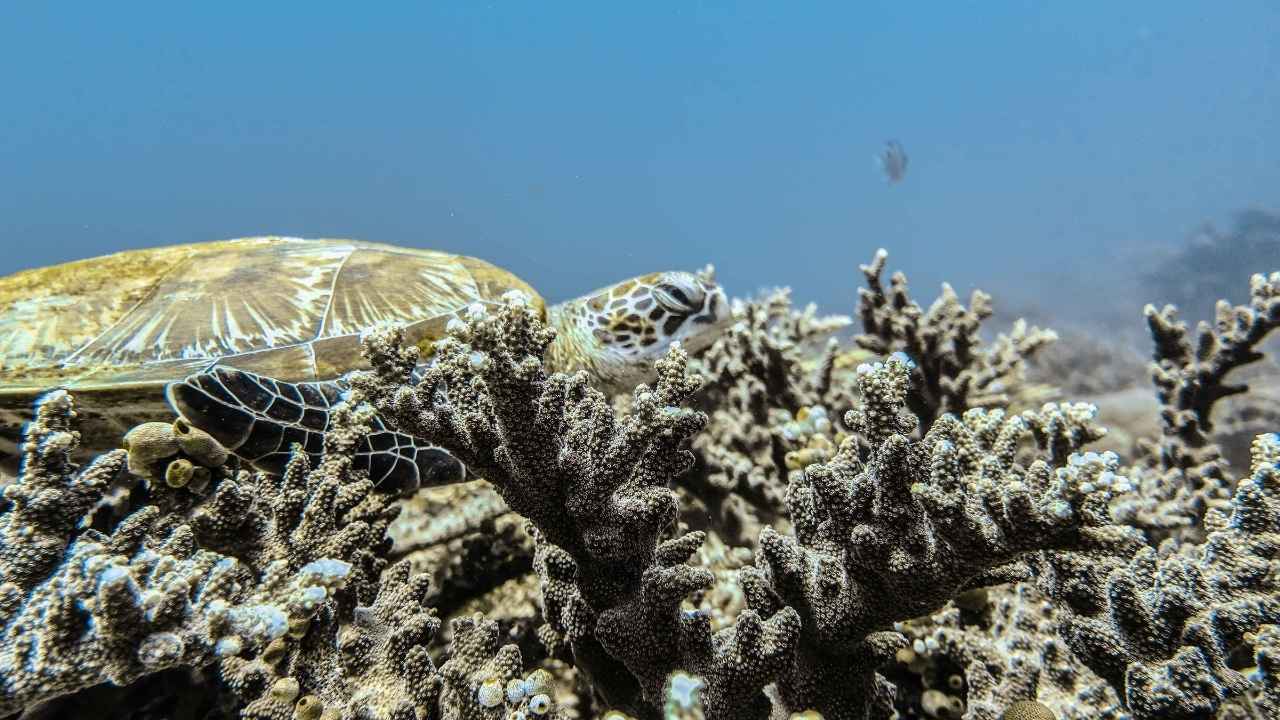
A sea turtle swims near the rocky coral seabed, representing a species that regularly lands on Lombok's coastline and is integrated as a responsible tourism attraction to maintain the stability of the marine food web: Wonderful Images (Modified)
This conservation-based educational ecotourism is designed to build emotional connection and ecological awareness through three structured activities:
- Education on life cycles and ecological roles: At hatcheries, visitors learn how turtles contribute to the stability of marine food webs. Green turtles act as major herbivores, maintaining healthy seagrass ecosystems by grazing in ways that stimulate shoot regeneration and prevent excessive sediment accumulation. Hawksbill turtles, meanwhile, control sponge populations, preventing these organisms from dominating coral-reef substrates.
- Hatchling release: Releasing young turtles into the open sea is an iconic attraction that offers personal fulfillment while fostering awareness of global biodiversity conservation.
- Nest-adoption schemes: These public-funding programs allow individuals or corporations to donate specifically to protect a nest from incubation through hatching.
In conservation operations, successful hatching depends heavily on temperature through the biological mechanism known as Temperature-Dependent Sex Determination (TSD). In marine reptiles, the temperature at which eggs incubate determines the sex differentiation of embryos. Global warming and climate anomalies pose a serious threat to the balance of wild turtle populations.

Because natural nests are vulnerable to extreme weather fluctuations and coastal erosion, conservation centers along Lombok’s coast move eggs to semi-natural nesting facilities or controlled incubators. This precise intervention stabilizes humidity and temperature within the optimal range, raises hatching success and artificially regulates the sex ratio to help maintain population dynamics in the future.
This conservation-ecotourism model demonstrates the principle of economic equity. Revenue from tourism fees helps fund operations without complete reliance on external donors. More importantly, the program creates a dignified path to new livelihoods: coastal residents who once extracted turtle eggs for illegal sale are now empowered as certified nest guardians, while tourist visits sustain MSME activity in surrounding tourism villages.
East Lombok’s hidden potential
In East Lombok Regency, Pink Beach (Pantai Tangsi) offers relatively calm coastal waters, with bays sheltered from the powerful waves of the Indian Ocean. Unlike the western area, crowded with concrete resorts, Pink Beach’s appeal rests on its stretches of pink sand. This geological-biological phenomenon does not result from inorganic mineral pigmentation; it comes from the accumulation of microscopic shells produced by Foraminifera, especially the species Homotrema rubrum.
These single-celled organisms attach themselves to the undersides of coral fragments or fringing reefs in shallow waters. When they die, waves break up their calcium-carbonate shells, which contain deep red pigment. The fragments settle and mix with white sand along the shoreline, creating the beach’s distinctive pink hue.
To protect ecological carrying capacity while maximizing the economic value of this biologically distinctive area, East Lombok brings together four integrated aquatourism attractions:
- Snorkeling and reef exploration in Ekas Bay and the surrounding Gilis: Small island groups such as Gili Petelu and Gili Gambir offer clear water for observing reef fish. Because the persistence of Homotrema rubrum depends heavily on the physical structure of fringing reefs, recreation is governed by a strict zoning system. Mooring buoys are required to prevent anchors from destroying the habitat that supports these pink-sand-forming organisms.
- Traditional boat ecotourism and bay tours: The isolation of some bays means visitors must use small traditional ketinting boats or speedboats as their main means of transport. These fleets are operated entirely by local fishing associations from Tanjung Luar or Sekaroh Village, so rental income and local-guide fees circulate directly within the coastal economy.
- Maritime cultural education and visits to fishers’ KJA: Taking advantage of the area’s proximity to the Ekas Bay aquaculture center, tourism is integrated with farming activities. Visitors can stop at KJA to see grouper, snapper and lobster being raised. The experience is paired with authentic seafood served with sambal pelecing, prepared by local food stalls along the beach.

A fisherman from the Ingin Maju Fish Farmers Group in Paremas Village harvests ornate spiny lobsters in a floating net cage, representing a high-economic-value aquaculture facility that is now elevated into an interactive educational ecotourism attraction for tourists: Luhkan Lombok Timur/Ishak
- Integrated coastal trekking at Tanjung Ringgit: For adventurous visitors, light water sports such as paddleboarding in calm bays are combined with trekking across the savanna hills of Tanjung Ringgit. This coastal highland features remnants of Japanese military caves facing the steep cliffs of the Indian Ocean.
The considerable potential of East Lombok requires mature destination management. Strengthening Pokdarwis capacity in waste management, providing adequate sanitation and mitigating conflicts over marine-space use under the RZWP3K spatial plan are essential prerequisites for the harmonious coexistence of Pink Beach conservation and productivity in Ekas Bay.
Sembalun’s appeal, a mountain water tower supporting coastal ecosystems
The health of marine ecosystems cannot be analyzed separately from the stability of the terrestrial landscape. The ecological transition from East Lombok’s coast is directly connected to the volcanic highlands of Sembalun District. Set in a fertile valley at the foot of Mount Rinjani, at an elevation of 1,150 to 1,200 meters above sea level, Sembalun has no marine attractions of its own. Yet it plays a vital ecological role as a “water tower” and a major catchment area at the heart of Lombok Island’s hydrological network.
The connection between the Rinjani mountain belt and coastal bays is sustained by major river basins, including the Dodokan watershed, which covers more than 273 km², and the Menanga watershed. Heavy rainfall captured by Sembalun’s protected forests infiltrates underground aquifers, is stored, and then flows steadily downstream to the eastern coast, including Ekas Bay and its surrounding waters.
This upstream-downstream relationship means that environmental fluctuations and exploitation in Sembalun directly affect the marine-tourism ecosystems below through several mechanisms:
- Vegetation cover and tree roots on Sembalun’s hills regulate surface runoff and slow erosion of young volcanic materials that are prone to landslides.
- Deteriorating land cover upstream, caused by deforestation or large-scale agricultural expansion, can sharply increase Total Suspended Solids (TSS) and chemical fertilizer residues such as nitrates and phosphates. These concentrated materials are carried by rivers to the sea. High turbidity downstream blocks sunlight, impairs photosynthesis by zooxanthellae microalgae in coral polyps, and creates seabed sedimentation that threatens oxygen circulation for lobsters raised in KJA.
Making use of clear, unpolluted spring-water flows, Sembalun is independently developing its inland waters into an agro-ecotourism center. Cold-water freshwater farming of Nile tilapia (Oreochromis niloticus) and common carp (Cyprinus carpio) is integrated with terraced horticultural landscapes of strawberries and vegetables. The excellent quality of mountain spring water produces fish with high-quality flesh and no muddy flavor, supporting local food security and providing a foundation for the highland tourism and culinary economy.
This hydrological and geographic proximity has encouraged integrated itineraries spanning different elevations, from land to sea. Visitors can begin in the cool mountain air, trek at Pergasingan Hill and enjoy freshwater cuisine in Sembalun, then descend through the valley to Lombok’s eastern coast for snorkeling, visits to commercial lobster cages and support for turtle-conservation releases. The journey presents Lombok as a connected ecological experience.

A view of the green Sembalun village valley surrounded by hilly landscapes and Mount Rinjani showcases a highland area acting as a primary water catchment zone whose hydrological infiltration strongly determines the survival of marine tourism ecosystems in coastal areas: Wonderful Images (Modified)
A future model of tourism governance
The development and transformation of marine tourism on Lombok offers a precedent: treating mountain terrain, river basins and seascapes as separate domains is a structural mistake. Stable high-value aquaculture production in Ekas Bay, balanced biological sex ratios among turtle hatchlings along the coast, and the preservation of Pink Beach’s Homotrema rubrum sands are parts of a single land-to-sea continuum. All depend heavily on strict conservation of water-infiltration areas in the Sembalun uplands.
Achieving equilibrium between nature conservation and equitable economic growth requires a firm commitment to Pentahelix collaboration, or the ABCGM concept, bringing together five pillars:
- Government (regulator): Controls environmental carrying-capacity limits, mediates spatial conflicts through strict enforcement of the RZWP3K, and ensures tourism fees flow back into health and sanitation infrastructure for coastal villages.
- Businesses and professional entities (Banglele Indonesia): Contribute intellectual capital through circular aquaculture innovations, including RAS and formulated feeds that comply with ecological standards, while developing tourism that delivers fair returns to all stakeholders in the supply chain.
- Local communities and village institutions: Serve as central operational actors, protecting nature as rangers, guiding visitors through local cultural knowledge and safeguarding the spirit of local hospitality.
- Academics and researchers: Supply scientific data on fluctuations in water-quality parameters, aquaculture feed-conversion efficiency and the effects of visitor thresholds, providing guidance for regulatory decisions.
- Mass media: Spread environmental literacy and educate modern travelers about responsible conduct when visiting ecologically sensitive destinations.
By combining mathematically assessed ecological carrying capacity, globally competitive aquaculture technology and an economic system that protects social equity for local residents, Lombok is on a promising path. The island is not merely reinforcing its standing as a leading domestic destination; it is projected to become a global benchmark for Blue Economy governance that is sustainable, inclusive and resilient in the face of change for generations to come.